Algorithm Categories
clypto organizes its catalog into ten taxonomy groups, following the classification used by the original MEALPY project and the survey Lee & Kim (2020).
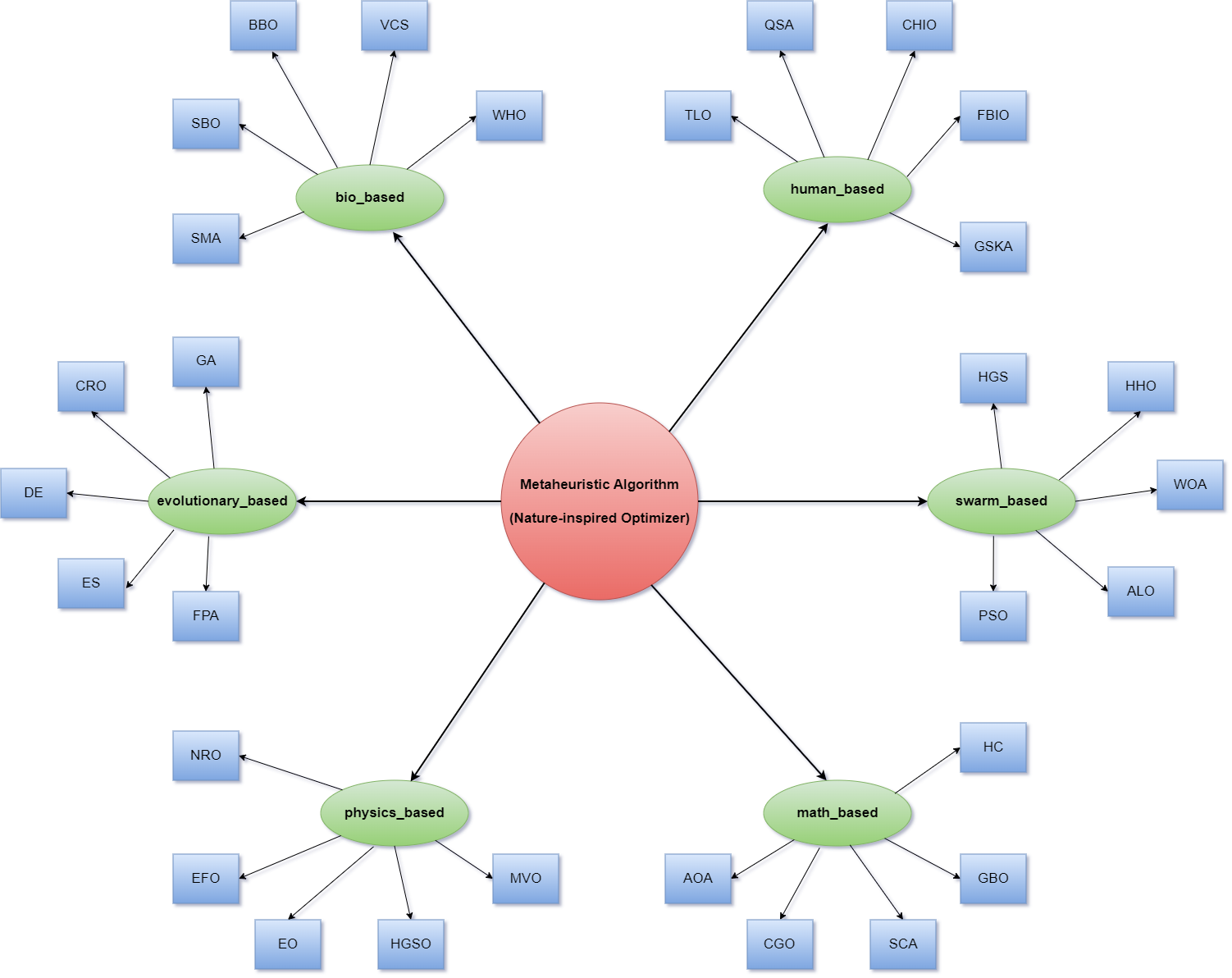
Category |
Inspiration |
Examples |
|---|---|---|
Darwinian natural selection and evolutionary computing |
GA, DE, SHADE, ES, FPA |
|
Collective movement and interaction of swarms |
PSO, GWO, WOA, ABC, HHO |
|
Physical laws and phenomena |
MVO, SA, EO, HGSO, RIME |
|
Human interactions and behavior |
CA, ICA, QSA, TOA, HBO |
|
Biological creatures and microorganisms |
BBO, IWO, SOS, SMA, TSA |
|
Ecological, immune, and network systems |
AEO, GCO, WCA |
|
Mathematical forms and laws |
SCA, AOA, CEM, RUN, HC |
|
Musical instruments and compositions |
HS |
|
Game-theoretic strategies |
THRO |
|
State-of-the-art CEC competition entrants |
LSHADEcnEpSin, IMODE |
How to read the catalog
Every category page is generated directly from the source tree. For each optimizer module you get:
a summary table of the module’s classes, and
per-class hyper-parameters and the reference to the original paper.
The naming convention is consistent across the catalog:
Original*— the method as published.Base*,Dev*,Improved*,Modified*,Enhanced*,Augmented*,Adaptive*— developed or hybridized variants contributed by the community.
Difficulty
The original project annotates algorithms by implementation difficulty, which is useful when you are learning:
Easy — few parameters, few equations, short source.
Medium — more equations, longer source.
Hard — many equations, long source, dense paper.
Hard\* — very hard; the paper is difficult to read.
Newcomers are encouraged to start with the easy and medium algorithms.
Warning
Before benchmarking Several algorithms have known concerns — weaknesses, latent bugs, or suspected plagiarism. Always review Known Issues before using an algorithm in a comparative study.